 Pear Docs
Browse commands with the interactive menu
Use pear --menu to find and run CLI commands from a filterable list and a real form, instead of memorizing flags.
pear --menu opens an interactive, terminal-driven menu for the whole CLI: pick a command from a filterable list, fill in its arguments and flags as a real form, confirm, and Pear runs exactly what typing the equivalent command would have run. It's the fastest way to discover what a command needs without leaving your terminal to check the reference.
Requires Pear 3.2.0 or newer—run pear versions to check what you're on. Not available on 3.1.x or earlier.
Need the pear CLI? Install it from install.pears.com, or prefix any command below with npx. See Install & upgrade for details.
Launch the menu
pear --menuThis needs an interactive terminal (a TTY). Run it from a script, a CI job, or any other non-interactive shell and it exits immediately with pear --menu requires an interactive terminal.
For scripts and automation, use the command's flags directly instead—see Scripting with --json.
Find a command
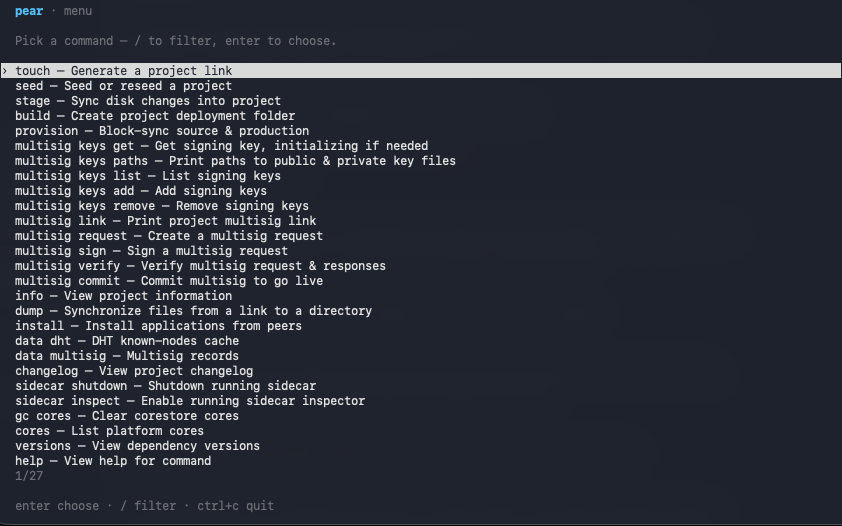
The menu opens on a filterable list of every top-level command, type to narrow the list, then pick the one you want.
Commands with subcommands (like gc or multisig) drill into their own filterable list of subcommands.
/— start filteringenter— choose the highlighted commandctrl+c— quit
Fill in the form
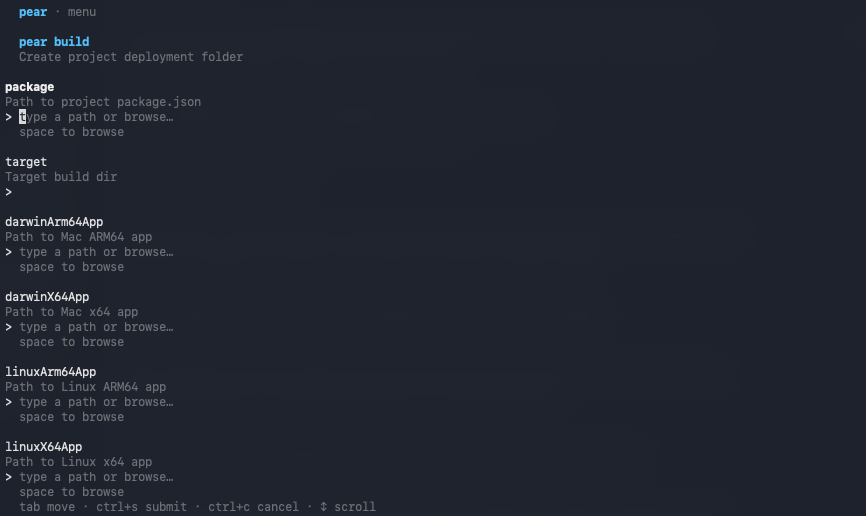
Once you pick a command, the menu builds a real form from its arguments and flags—one field per parameter, using the same descriptions and defaults documented on the CLI reference.
Fill in what you need, leave the rest at their defaults, and confirm to run the command.
The result is identical to typing the equivalent pear <command> --flags yourself—the menu is a different way to assemble the same call, not a different tool.
tab— move between fieldsctrl+s— submit and run the commandctrl+c— cancel
Forms with more fields than fit on screen also show ↕ scroll.
When to use it
Use the menu when you're exploring a command's flags—new to Pear, or new to a command you don't use often—and don't want to context-switch to the reference to check a flag's spelling or default. Use flags directly once you know the shape of the command you want, for scripts, CI, or anything else that needs to run non-interactively.
See also
- Command Line Interface (CLI) reference—the full command list the menu is built from.
- Scripting with
--json—the non-interactive path for automation. - Troubleshoot common issues—for problems beyond what this guide covers.